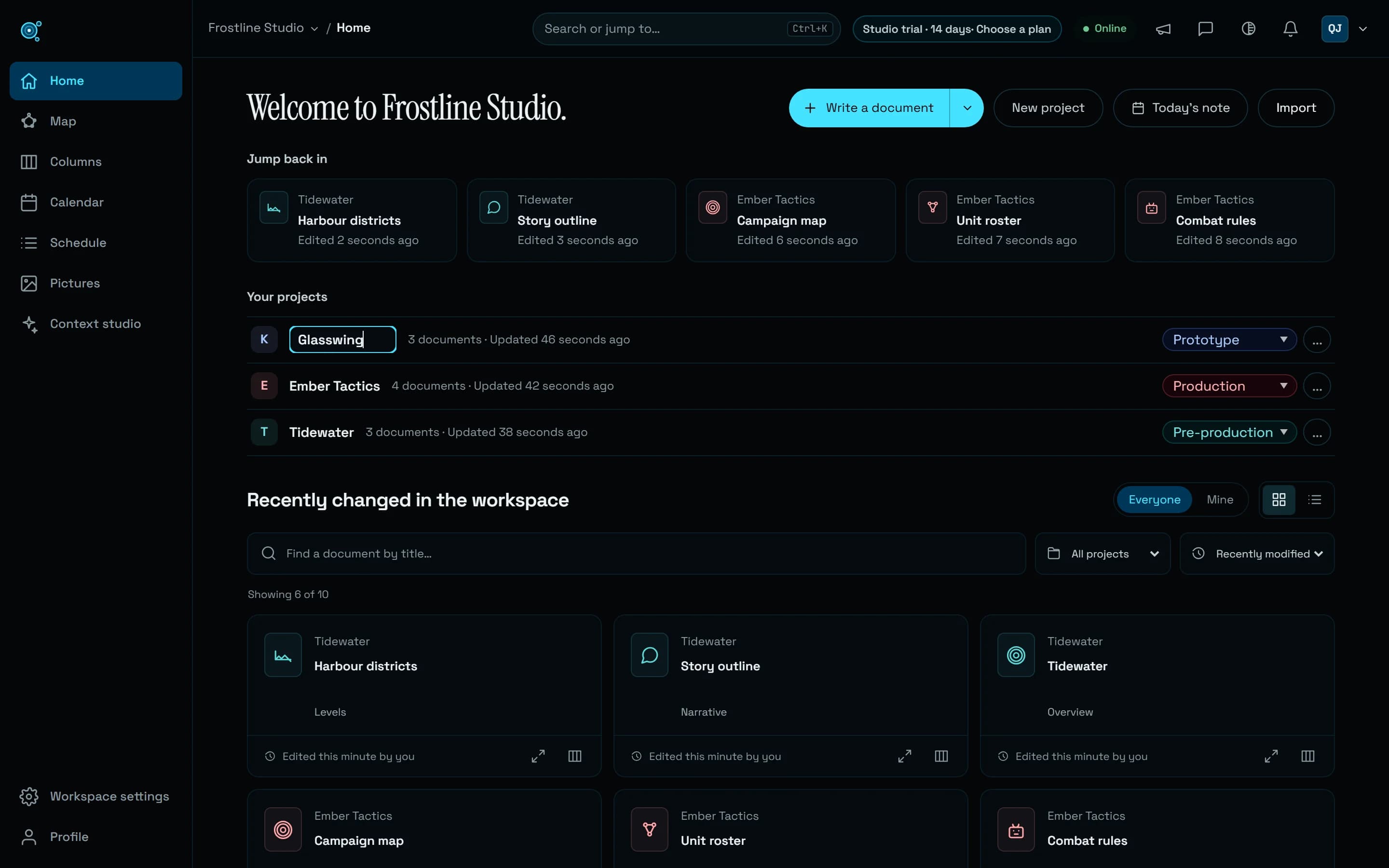
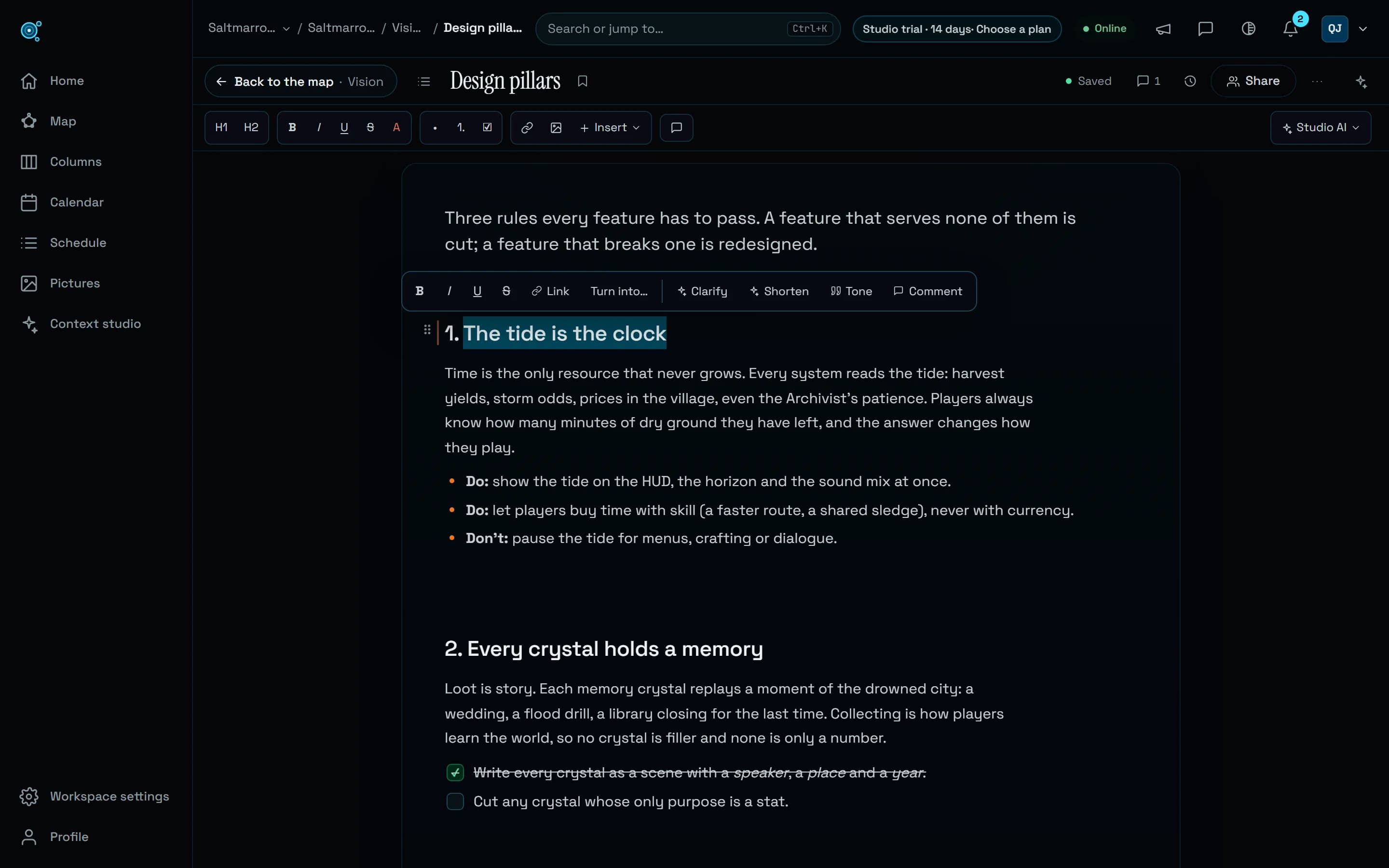
Open the sample game behind the site, in the live demo.
Saltmarrow, the fictional game this site shows, is now in the live demo: 44 linked documents, with live boards, timelines and progress, and no account.
Every capture on this site comes from Saltmarrow, a fictional co-op game made by four sample teammates in a real Nodary workspace. Until now the live demo opened a different sample studio, so the page about the harvest economy could not show you that economy. The demo now holds Saltmarrow itself, as the site shows it.
The project the site describes
Open the live demo from the home page and the map shows Saltmarrow: eight areas around the project’s own page, two folders, and the links between its forty-four documents with their reasons. The Studio tabs and each craft’s page open their own document: the art bible from the art review page, the harvest economy from balancing, the string table from localization, the Drowned Archivist’s dialogue from the dialogue page, and the milestone plan from production.
Live views you can read
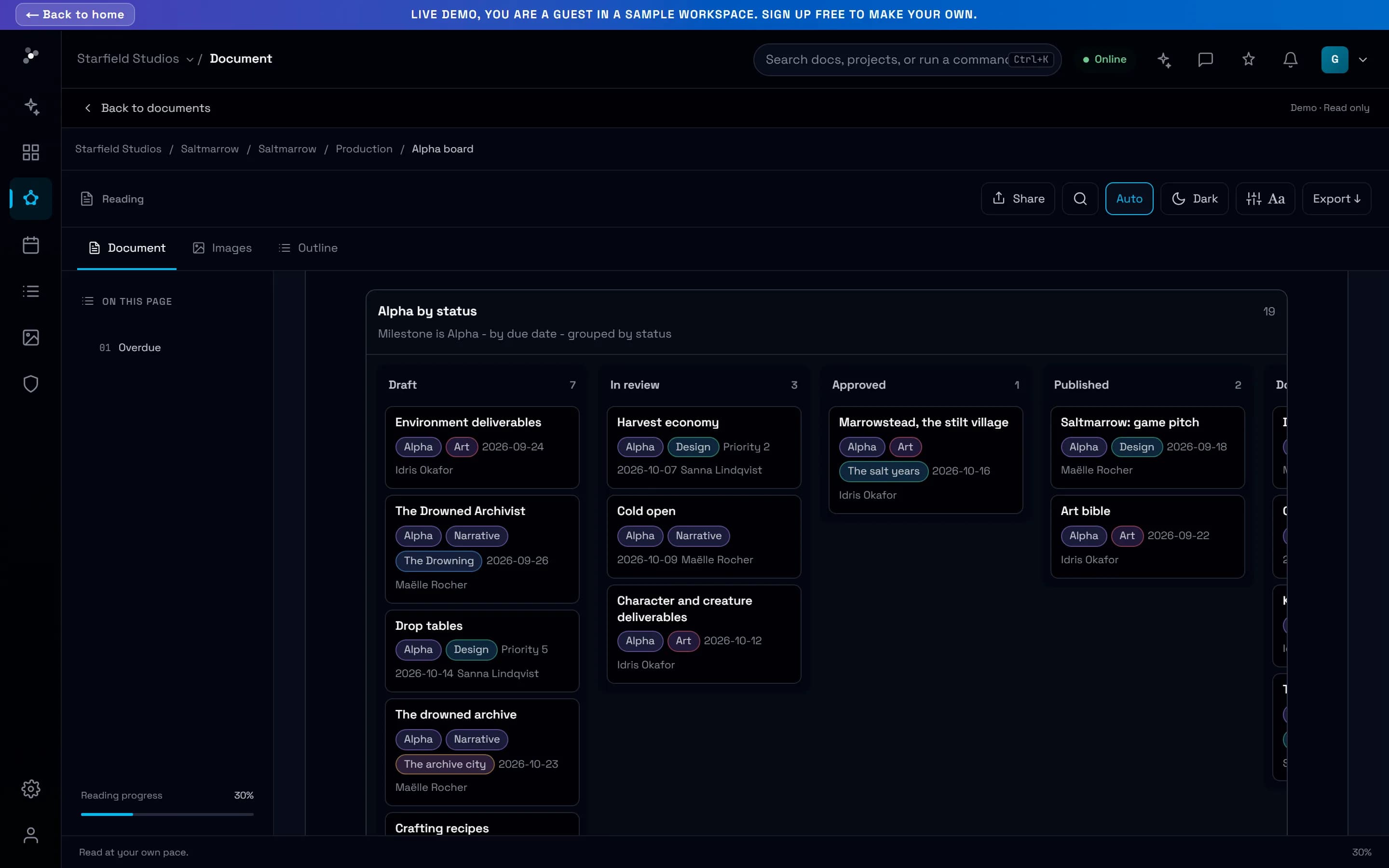
Saltmarrow plans its work with live views, and they now show their documents when a document is read, not only in the editor. The Alpha board puts every Alpha document in a column by status, a table below it lists what is late, the world chronology places each place and character by its in-world year, the vertical slice table draws its cut line at a 45-day budget, and the milestone plan says how much of Alpha is finished. Choose a card or a row to read that document. In a workspace, reading a document shows its live views the same way, and boards, tables and filters name each status as people say it, in their language.
Documents that do their job
The sheets compute: change nothing and still read the yields per tide, the restoration curve and its chart. The art bible’s references say which were approved or rejected, and by whom, beside the core palette. The key art reviews keep both passes, the first sent back and the second approved. The drop tables, the string table with its five languages and the Archivist’s branching dialogue are there too, each linked to the documents it depends on.
The conversation, too
Each document keeps its discussion as the team left it. Its Discussion tab lists every thread with its replies and what it is about: a passage, a cell of a sheet, an element of a diagram, or a note pinned on a picture. On the key art reviews, Show on the picture opens the first pass with the art director’s three notes drawn on it, a circle around the sun, a box around the Gothic arches and a stroke across the clouds. In a workspace, reading a document shows its discussion and its notes on pictures the same way; replying and resolving stay in the editor.
Try it in your workflow
- Open the live demo from the home page: the map shows Saltmarrow.
- Under Production, open the Alpha board and choose a card to read its document.
- Open the milestone plan to see how much of Alpha is finished.
- Open the key art reviews, then Discussion, and show a note on the picture.
The demo is read-only and a snapshot of the sample project: you cannot reply to its discussions, its version history is not part of it, and Studio AI is off. Its dates move with today, so a due date stays as near or as late as it was when the snapshot was taken, while the text of the documents keeps its original dates. The progress view counts the status changes in the snapshot, so it gives a pace only after a week of them. Saltmarrow’s documents are in English.