The linked workspace for your team and its AI agents.
Specs, wikis, spreadsheets, diagrams, boards and plans live on one map of linked documents, each able to carry an owner, a due date and a review. Claude, ChatGPT and Cursor read and write it with your permissions.
Shown: Saltmarrow, a sample game project documented in Nodary.
Every project is a thousand documents. Nodary keeps them in one sky.
They pile up
The spec is in a wiki, the references on a board, the numbers in a spreadsheet, the translations in another, the decisions in a chat. Nobody, person or AI, sees the whole.
Every document becomes a star
Specs, pitches, references, sheets and translations each become a document on one map, filed in clusters you can open like folders.
Links say why
Related, inspired by, blocks, depends on: a link carries its reason, and a blocker reads the right way from either end. Producers see what waits on what.
Your agents see the same sky
Connect Claude, ChatGPT or Cursor through MCP. They read the context your team keeps and write back into it, signed in your name.
One workspace, whatever your team makes.
Nothing in Nodary requires a game. Teams can use the same linked documents for products, client work, research and stories.
- Game studiosDesign documents, art review, balancing, string tables and milestones, each with a real tool.
- Product and engineering teamsSpecs, decisions and technical designs linked to the work they shape, in one map your agents can read.
- Agencies and client workA project per client, with its briefs, references, reviews and files in one place.
- Research and consultingSources, interviews and findings linked to the decisions they inform.
- Writers and worldbuildersLore, characters, timelines and screenplays, linked as one world.
Your agents work in the same workspace. With your permissions.
Nodary runs a real MCP server. Connect Claude, ChatGPT, Cursor or Claude Code and they read the documents, sheets and decisions your team keeps, then write back: create documents, fill tables, leave notes on pictures, plan a milestone.
- Read any document, sheet or board, with its links and history
- Write documents, fill sheets and string tables, file and link stars
- Review art: find what waits, look at the picture, decide with a reason
- Plan: list what is late, who is blocked, and whether the milestone lands
Agents act as the person who connected them, with the same rights. Every decision they make is signed in that name, writes can be retried safely, and nothing an agent writes can forge who decided.
MCP is included in every plan, Free included.
Works with any MCP client, including Claude, Claude Code, ChatGPT, Cursor, VS Code.
claude mcp add --transport http nodary https://nodary.ai/api/mcpFound 3 stars.
5 pictures for changes, recently changed documents first. get_image shows one, get_moodboard a whole board.
Art review in this project: 0 references undecided, 7 approved, 1 rejected; 28 deliverables (image grids, single images, boards): 2 waiting for a decision, 19 approved, 5 sent back for changes, 2 rejected; tags used most: environment (2), key-art (2), colour (1), gameplay (1), lighting (1), materials (1), props (1), target (1). List what waits with find_pictures (status undecided) and decide with update_pictures.
Created star "Playtest notes" inside the requested cluster.
Linked the two stars ("questions").
8 items from "Crystal" weighted by "Weight" (total 10000). Rarest: Archivist's tear at 0.2% a pull, 500 pulls on average, 1151 pulls for nine players in ten. With a guaranteed Drowned lens on pull 150: 99.1 pulls on average, 150 for nine players in ten. Every item: 543.2 pulls on average, 1155 for nine players in ten (exact).
For game studios: every craft in the same graph.
Nodary was built first for game studios. The documents that make a game are not all text: Nodary has a real tool for each of them, and links them all.
Design documents that stay true
Write the game design document as linked pages: pillars, systems, characters, levels. Mark what is canon, what is exploration and what was superseded.
- Diagrams written as text (Mermaid), rendered live
- Live views: a table, board or timeline of any set of documents
- Templates for GDDs, mechanic specs, tech designs and more
Truth status is set by people; nothing is marked canon automatically.
Review art where the brief lives
Moodboards with approved and rejected references, deliverables decided in one place, notes pinned and drawn on the picture, and a feedback sheet ready to send to an outsourcer.
- Approve, send back for changes or reject, signed with who and when
- Circles, arrows and strokes drawn on the picture, numbered
- Palette check, value study and mirror in the viewer
Outsourcers without an account receive the sheet as a PDF; there is no delivery link for them yet.
Balance in a real spreadsheet
Sheets with formulas, references between cells and cell notes, inside the document that explains the rules. Point a loot table at the drop-rate panel and read what players will feel.
- Chance per pull, pulls until half or nine in ten players have an item
- Pity rules and full-collection estimates, exact where the maths allows
- Import from Excel or CSV with a preview
Formulas cover the common functions; macros and pivot tables are not supported.

Strings next to the design they come from
A sheet becomes a string table: one row per key, a column per language, each translation with its state. Length limits and lost placeholders are flagged before they ship.
- States: missing, draft, reviewed, final, source changed
- Exports for Unity, Unreal and Godot: CSV, JSON, .po and XLIFF
- A data feed your build can fetch
Nodary is not a translation agency or a full TMS: there is no translation memory.

Dialogue and scripts as documents
Branching dialogue with the player’s choices, its structure checked before anyone plays it, and screenplays written in Fountain, both linked to the characters and quests they belong to.
- Choices pointing nowhere and unreachable lines flagged
- A Yarn Spinner script to import into Unity or Godot
- Script, play-through and graph views of the same conversation
Nodary checks dialogue structure; it does not run your game’s logic.

Know if the milestone lands
Assignees, due dates, reviews and blockers on every document, boards and timelines for any set, and a progress view that compares the pace with your target date.
- Burn-up from the recorded status history
- Cut lines by budget for scoping a milestone
- Activity: who changed what, and when
Status history starts on 29 September 2026: older pace is not guessed.
Feedback drawn on the picture, decided once, signed.
The key art for Saltmarrow went through two versions. The first was sent back with notes drawn where they apply; the second was approved. Both decisions say who made them, and the outsourcer gets one sheet with everything.

Changes asked by Idris Okafor, art director
- 1. Too busy: lose the sun, keep one lantern glow. The lantern on the walkway has to be the only warm point.
- 2. The Gothic arches on the left compete with the lighthouse. One silhouette per plane.
- 3. Cloud texture is fighting the tower tops. Calm the sky in this band.

Approved by Idris Okafor, art director
See the feedback sheetSample art made for the Saltmarrow showcase. The pins and marks are drawn by the same code as in Nodary.
Ask the loot table what players will feel.
This is the drop-rate maths from Nodary’s spreadsheet panel, running here. Change the weight of the rare crystal or the pity rule, and read the answer in players, not percentages.
The table: salt chunk 600, brine pearl 240, tarred rope 110, tide compass 40, and the memory crystal. Exact maths for a single item, nothing simulated.
Open the free drop-rate calculatorFree to start. Pay per seat as you grow.
Free holds a small team and one project with no card. Pro and Studio add projects, storage and a monthly Studio AI allowance in Comets.
See every plan- Free
- €02 members, 1 project, no card
- Pro
- €15per seat per month, billed monthly
- Studio
- €29per seat per month, billed monthly
What shipped lately
Read the journal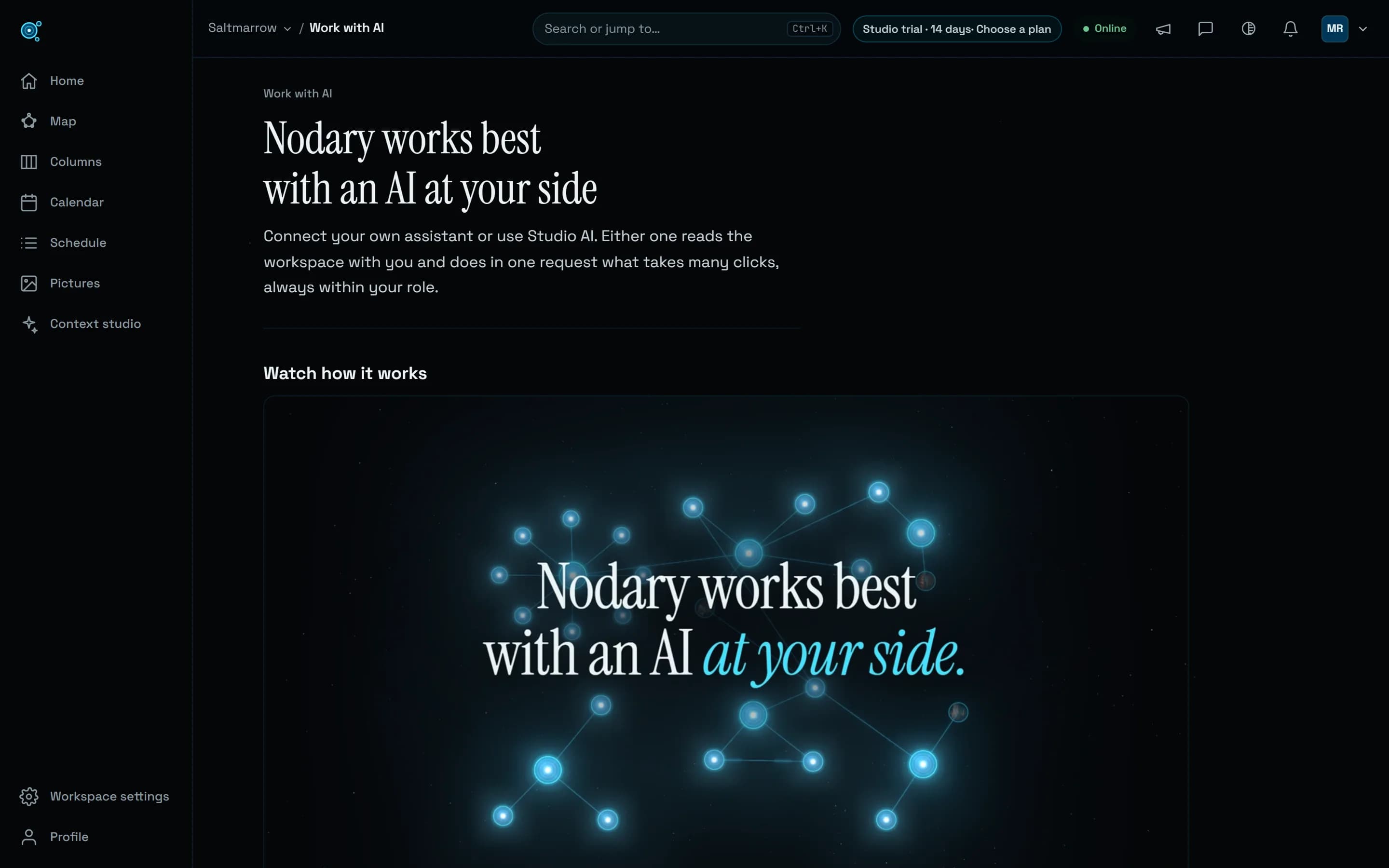 Nodary works best with an AI, and now it says so from the first minute.New members are welcomed with a guide to working with an AI: your own assistant connected over MCP, included in every plan and spending no Comets, or Studio AI, built in. A short film, prompts to try, and what an AI does here that buttons do not.
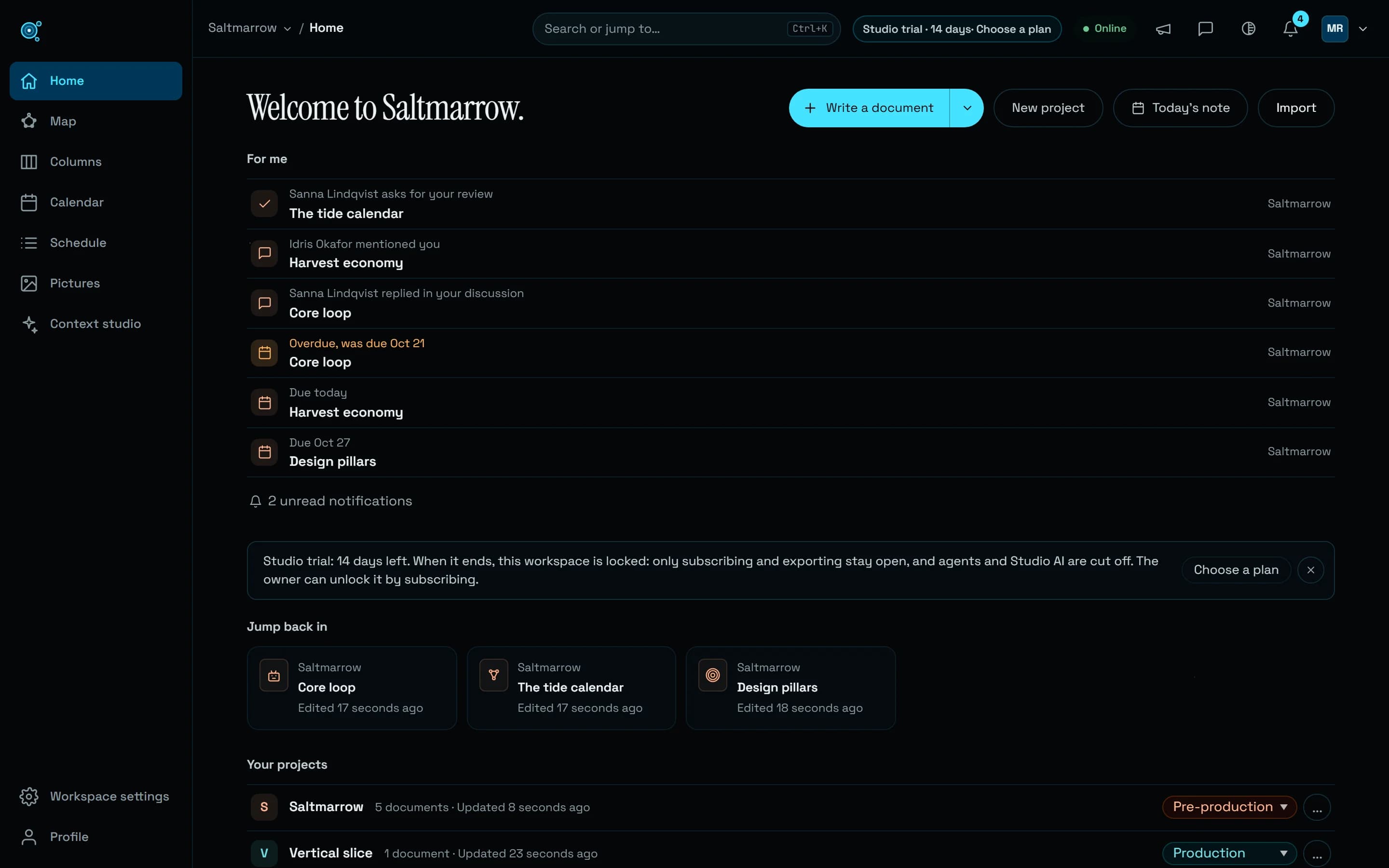 One email a day, and what waits for you on Home.Email digests now means one email a day, in your morning. Home lists the reviews, mentions, replies and dates that wait on you, and every notification email has a one-click unsubscribe.
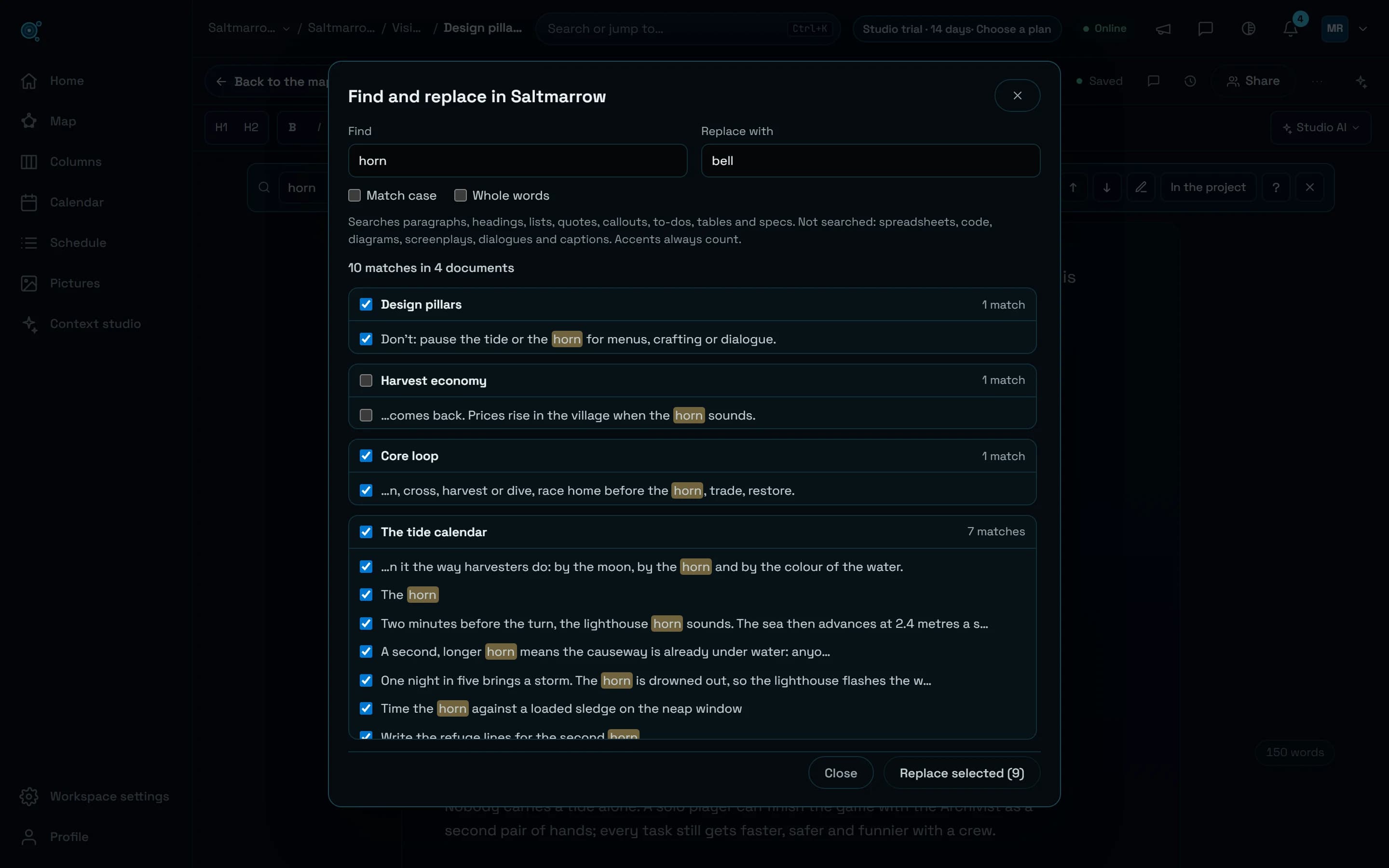 Find and replace across a project. Export to Word.Find and replace in a document or across a whole project, match by match. Move blocks into a linked document, and export any document as a Word file.
Give your team one sky.
Start free with your team, or open the live demo first. No card, no installation.